Are conservatives & Christians happier? Should we care?
The wrong way to sell religion.

Here's one thing conservatives believe they have on the libs: they're happier. Conservative hearts swell with the joy of faith, family and flag, while liberals are anxious, godless wretches. If you spend enough time in the right corners of the internet or regularly listen to anything JD Vance says, you run into this narrative a lot.
It's true, conservatives are more likely to say they're satisfied with their lives in surveys. For instance, this 2021 survey by Gallup:
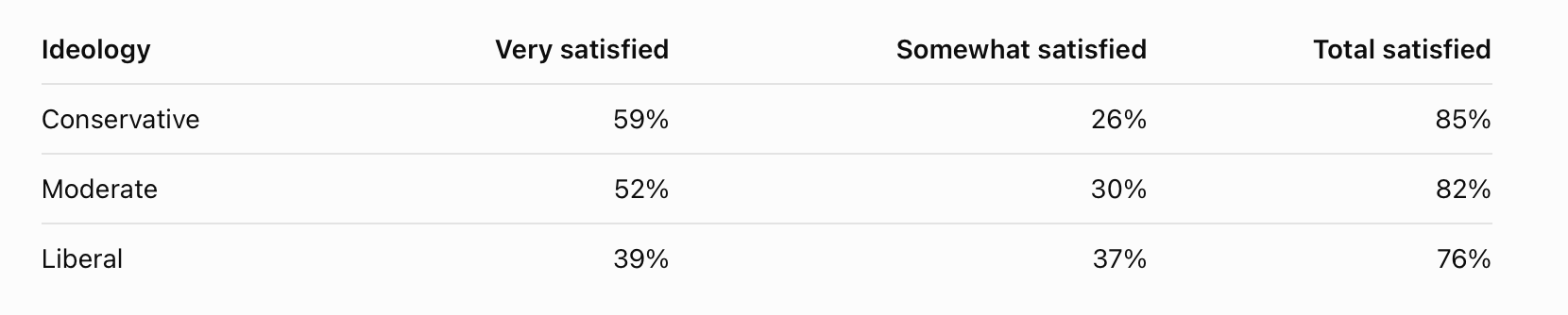
Another recent study found that liberals were considerably more likely to rate their mental health poorly. However, the same study found that when asked to simply describe their mood, the apparent gap largely disappeared. This is consistent with the idea that mental health issues carry less of a stigma (and perhaps even some rewards) in liberal circles. This is just a fancy of way of saying that we're snowflakes.
A particularly prolific purveyor of this narrative is Brad Wilcox, a University of Virginia professor of sociology and happily married father of nine. His book is Get Married: Why Americans Must Defy the Elites, Forge Strong Families, and Save Civilization.
Wilcox's Twitter feed is a steady stream of studies revealing the benefits of traditional lifestyles. For what it's worth, Wilcox seems like a decent guy and his general posture is concern, rather than condemnation, for the unmarried and unchurched.
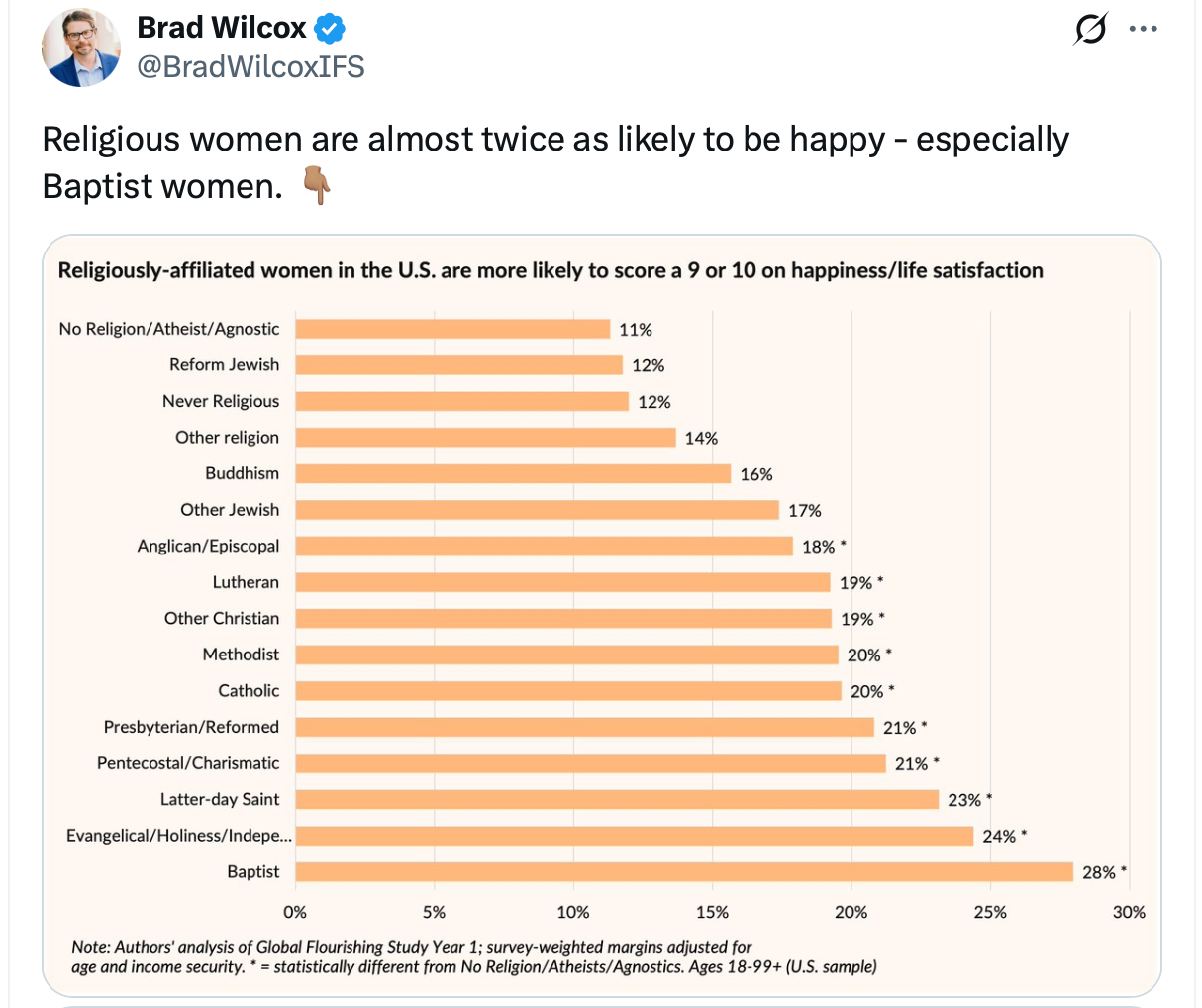
Here, for instance, he points out that the more hardcore the religion, the happier its adherents. (My words, not his.)
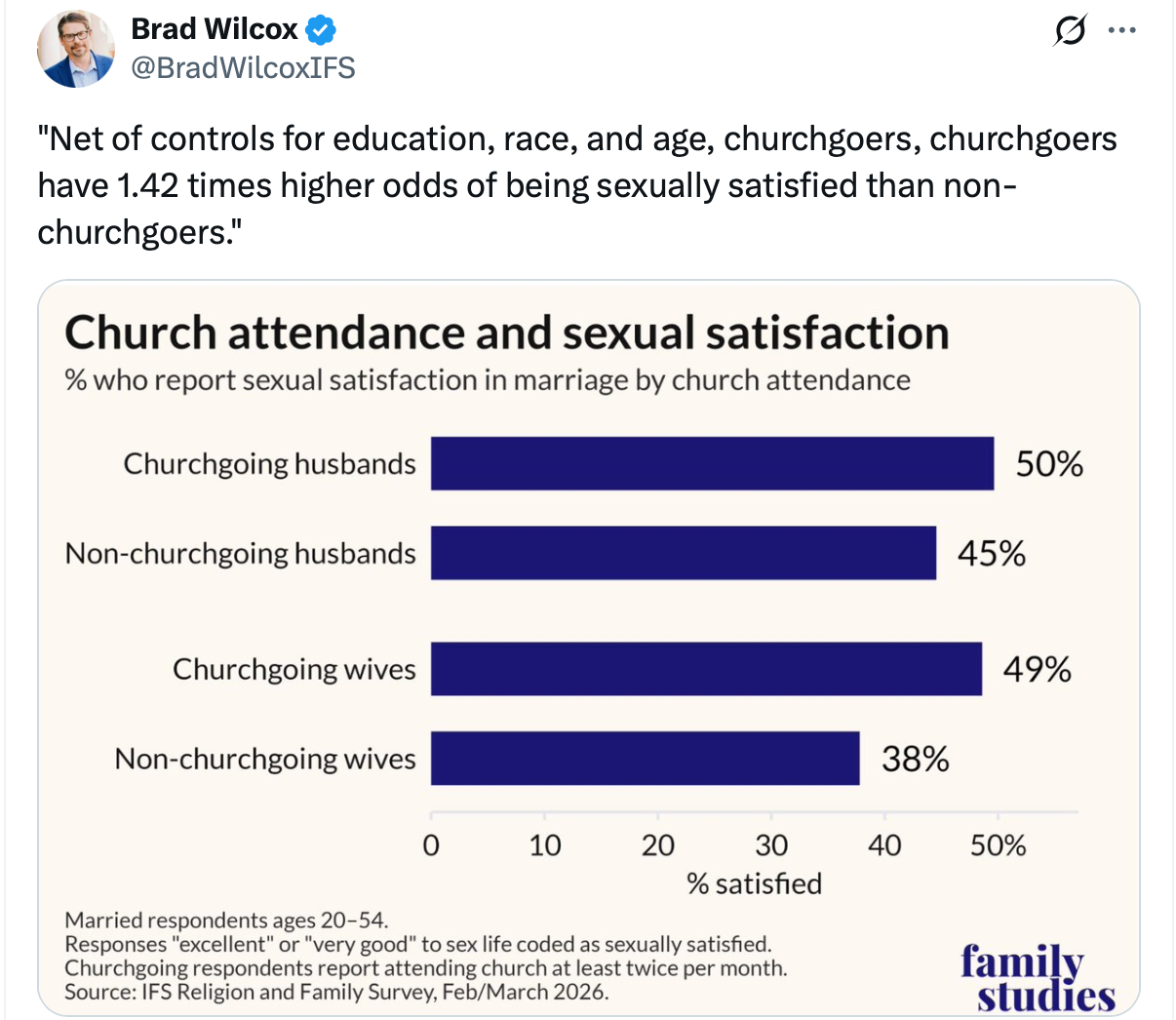
This one finds Christians have happier bedrooms:
Boo atheist singles:
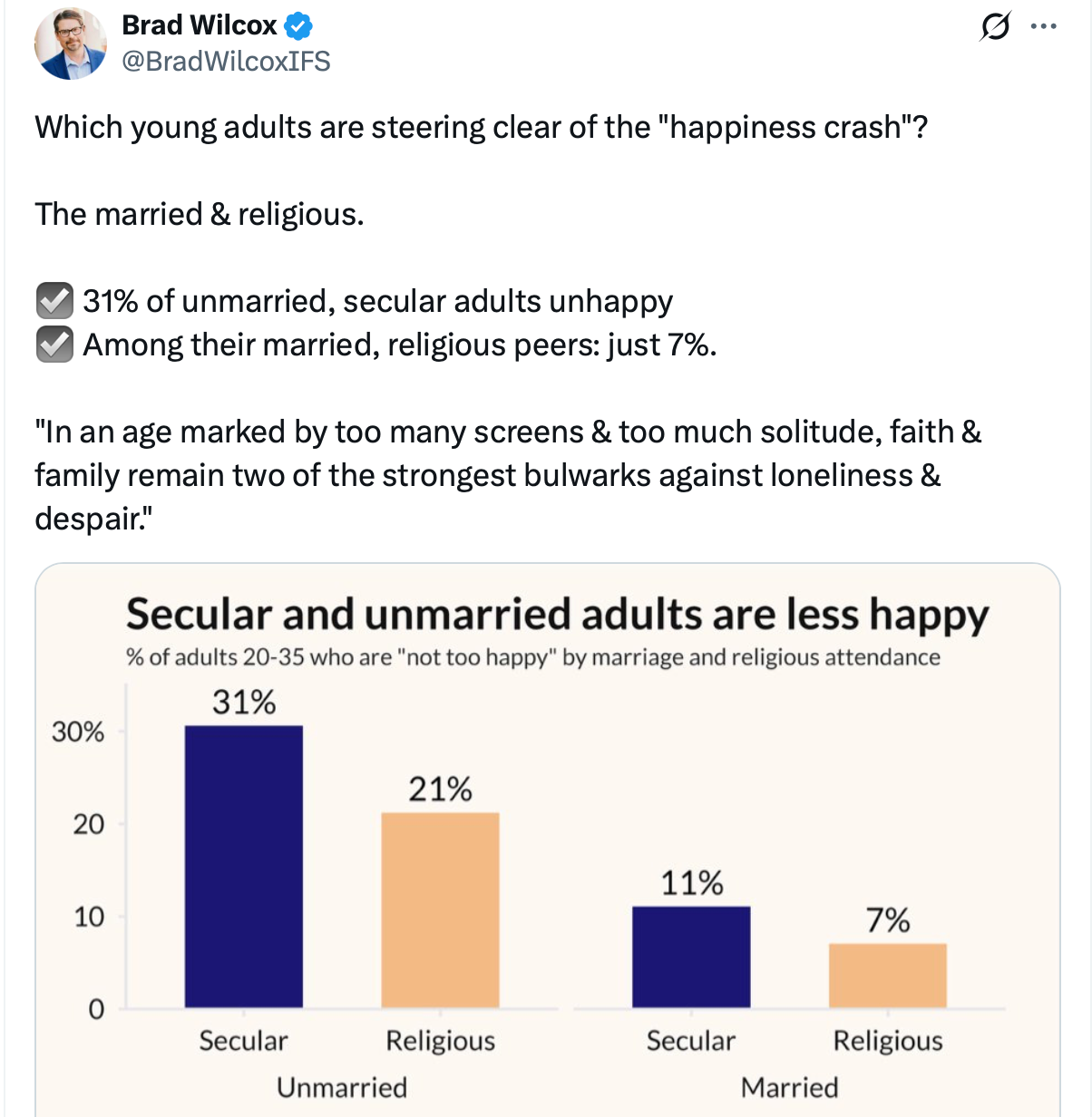
More yay for religion:
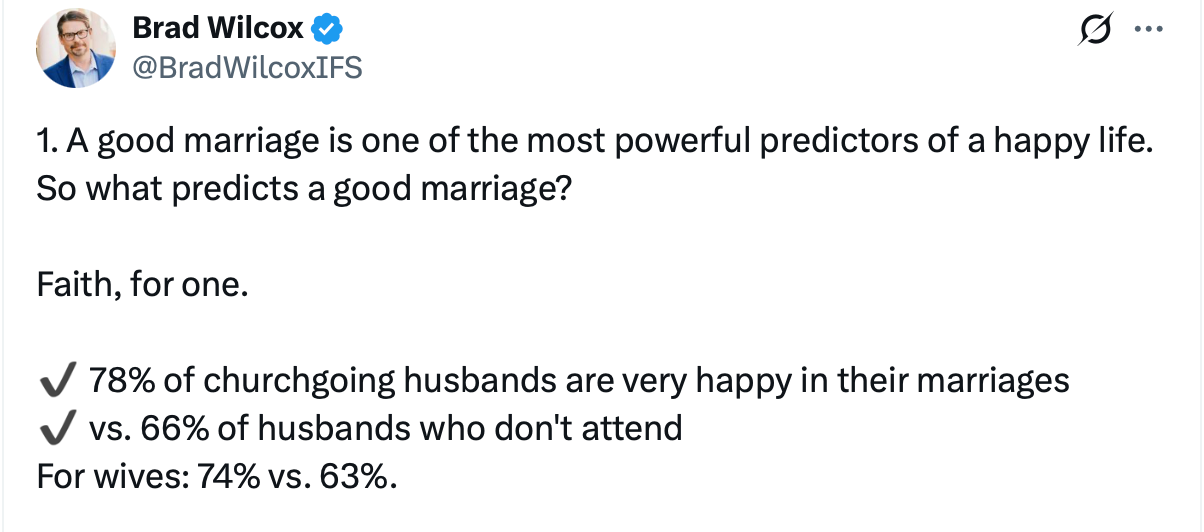
In an article last year, Wilcox linked lower reported levels of happiness among liberal women to their lower rates of marriage and church attendance. His conclusion:
The bottom line, then, is that any efforts to bridge this ideological gap in young women’s emotional well-being will seemingly require not only a change in thinking but also a renewal of young liberal women’s connection to America’s core institutions—family and faith.
In general, I don't find the stats particularly compelling or worthy of the sweeping narrative that Wilcox assigns to them.
It's not surprising to me, for instance, that regular church-goers score higher on all kinds of wellbeing metrics. First, engaging in any weekly communal activity probably correlates with greater life stability and health. Second, church offers community and social engagement, which tends to make people happier.
But there are non-religious avenues to all of this good stuff. If we find out that those who regularly attend meetings of the Sons of Italy report moderately higher levels of sexual satisfaction, should we conclude that ethnic solidarity is key to erotic fulfillment?
My bigger problem is the idea that greater happiness is reason to become a Christian. Greater happiness is a good argument for joining a pickleball league or adopting a kitten or marrying a person you love. But it's not a good argument for believing that Jesus Christ is the son of God.
It's never made sense to me when people make these sort of practical and dare I say terrestrial arguments for religion, particularly Christianity. I can't help but view it as an implicit surrender on some of their religion's central claims.
The traditional argument for Christianity is not that it could moderately improve this life, but that it will radically improve the next one. Greater happiness during your remaining years on Earth is pretty small potatoes compared to the prospect of forever bliss in heaven or eternal torment in hell.
And yet, we see religious leaders and their allies make these kinds of appeals because the traditional arguments for their faith simply aren't landing. OK, so I can't convince you that God exists and is watching you at all times, but what if I told you it'll help you get laid?
"You're depressed because you don't believe in God. You should believe in God." I'm sorry, it doesn't work that way.
I'm sure religion makes a lot of people happier. But religion isn't going to make you happy if you don't believe in it. Indeed, the decline of church attendance is largely a result of people leaving churches that didn't make them happy!
The same holds for marriage, which is Wilcox's main thing. I think marriage can be great (love you sweetie!) but it's not something we can simply make happen for people. They have to, ya know, fall in love and stuff.
So no, the solution to our secular liberal misery is not conservative religion. But it is true that nonbelievers could probably use more community. And it is true that there are segments of the left prone to wallowing in victimhood and doomerism.
The good news is that, if the most recent elections are any indication, cheerful and hopeful liberalism seems to be ascendant. Many of the stars of the 2026 midterms ran as opponents of cynicism and champions of civic decency and duty. Some of them made heavy use of religion, others barely mentioned it. These candidates denounced the status quo in Washington — but often contrasted it with the fundamental goodness of everyday Americans.
Maybe if the elected leaders of our communities tried to foster connection instead of division, we would all be happier. Just an idea!
Please share with your friends and encourage them to sign up for the Neighborhood Matters newsletter! It is totally free but I would also totally appreciate voluntary one-time contributions or subscriptions. Thank you!