A home without parking
Why I'm glad I have to park in the street.
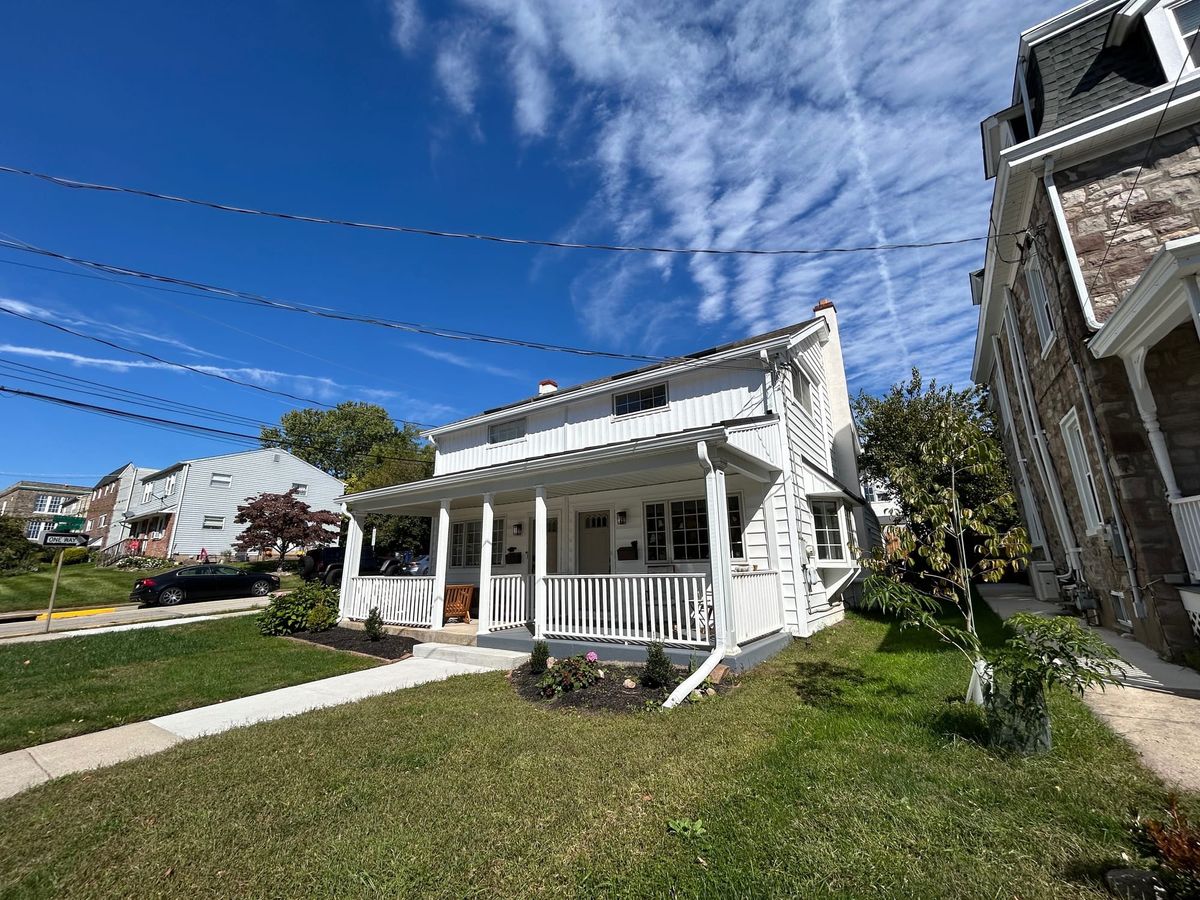
We recently bought a house in Ambler, Pa., just a block off the borough's main commercial corridor, Butler Ave. The only thing that really mattered to me in our home search was location, and ours really delivers on that front.
According to my count on Google Maps, within a 10-minute walk (half-mile) are 40 restaurants, coffee shops, bars, ice cream joints and the like. There are also a dozen hair salons and barbershops, a library, a grocery store, a movie theater, a theater theater, an improv club. Two new bookstores — one new & one used — just opened around the corner in the past few months. There's only one astrologer, but based on the rave reviews she's gotten on Yelp, she's the only one you'll ever need to see.
Like many of the older homes in Ambler, it's a "twin." In contrast to a duplex — a building with two units — twins are two distinct single-family homes that share a wall.
Each home sits on a distinct lot. Our lot, for instance, is 1,900 sq ft — tiny in comparison to what you expect from a single-family lot in much of the country. For instance, until recently, the legal minimum for a single-family lot in Austin, Tex. was 5,750 sq ft. There were also additional regulations requiring each house to have a sizable front yard and back yard and to be a certain distance from any neighboring house.
But my favorite way that our house is different from most U.S. suburban homes: there's no garage or driveway. We gotta park on the street.
Most people are puzzled when I say that I'm happy my home lacks parking. Why would I wish such a hardship on myself? Why would I prefer the inconvenience of competing with my neighbors for spots on the street?
It's not that I necessarily look forward to the occasional frustration of driving a block or two over to park. But I like what it represents: a cost-savings. Like the shared wall and the small yard, the lack of parking makes my house cheaper. These concessions allow me to afford a home within walking distance of all that stuff I mentioned earlier. It's the free market at its best.
Off-street parking may be a nice thing to have, but it is not a necessary thing. The belief that it is necessary is one of the most disastrous errors of 20th century urban planning. It has done tremendous, irreversible harm to American towns and cities.
I'm hardly the first to say this. It's now been 21 years since the problem was most famously explained in Donald Shoup's 760-page treatise: The High Cost of Free Parking.
Shoup's main point is that Americans are paying a massive hidden cost for what can only be described as parking socialism. Requiring homes and businesses to provide "free" off-street parking is not only a major subsidy for the auto industry, but it creates urban landscapes that are very difficult and unpleasant to navigate outside of a car. Instead of old fashioned Main Streets you get freeways occasionally punctuated with strip malls and big box stores.
Parking requirements also warp the housing market. It's not just that it costs money to build the driveway, but it requires you to buy more land for each house. This is the kind of regulation that makes it hard to build lower-cost types of housing, like rowhouses or twins, and guides developers towards building large single-family houses. If you're only building one type of house, then you're only going to get one type of buyer.
The housing argument is what has motivated a number of cities across the country to rethink parking mandates. Austin, the archetypical Sunbelt car-centric city, used to have a complicated series of rules requiring a certain number of off-street parking spots for every type of use, from single family homes to office buildings and bars (you have to make sure it's as easy as possible to drive to and from a bar). In 2023, City Council voted to eliminate all of it. Does that mean developers have stopped building garages and driveways? Of course not. In a city largely built for cars, people still expect parking at their destination.
But every bit of unnecessary pavement a city is spared is a win. A little more housing, a little more green space. And there are even some instances of developments without parking — one recent affordable housing project was able to build twice as many units by doing away with parking.
One of the great things about towns like Ambler is that they took their form before pro-car planning and regulation took over. As any longtime resident will tell you, it isn't nearly as affordable as it used to be, but the great variety of housing types still provides access to a far greater range here than in places where large lot single-family homes are the only option.
Not everyone in Ambler is as sanguine about the parking situation as I am. A friend whose home also lacks a driveway is regularly frustrated by the fact that the street in front of his home is often parked up by patrons of nearby restaurants and bars. He looked into building a driveway on his property, but when he discovered it would cost at least $10,000 to build the driveway and possibly another $20,000 to relocate a fire hydrant, he opted to continue enduring the indignity of occasionally parking a street or two over.
I think that pretty much sums it up. When you're confronted by the true cost of parking, all of a sudden it no longer seems so important.
If this article was forwarded to you, make sure to subscribe to the Neighborhood Matters newsletter for more commentary and analysis on urbanism and community-building.
Neighborhood Matters is free, but coffee tips are greatly appreciated!