We all love strangers
We should embrace it.
A few weeks ago I accompanied my wife and 7-year-old daughter to CatVideoFest 2026, an hour and thirteen minute collection of internet cat videos. A friend joined us at the last minute.
Why would we spend good money to watch a series of 30-second social media reels? Shouldn't a trip to the historic Ambler Theater offer a break from the short-form video hellscape that now rules the internet?
And yet, watching dumb cat videos with two dozen neighbors is a very different experience than watching them on your phone. You're not just enjoying the content but everybody else's reaction to it. You don't know most of these people and you'll probably never know them, but you appreciate their presence. It enhances your experience.
Similarly, you don't go to restaurants or bars just because you're too lazy or incompetent to cook your own food or mix your own drinks, although that may very well be part of it. You're seeking an ambiance. And the most important ingredient to a solid ambiance is other people.
We all understand the value of strangers on some level but we rarely acknowledge it explicitly.
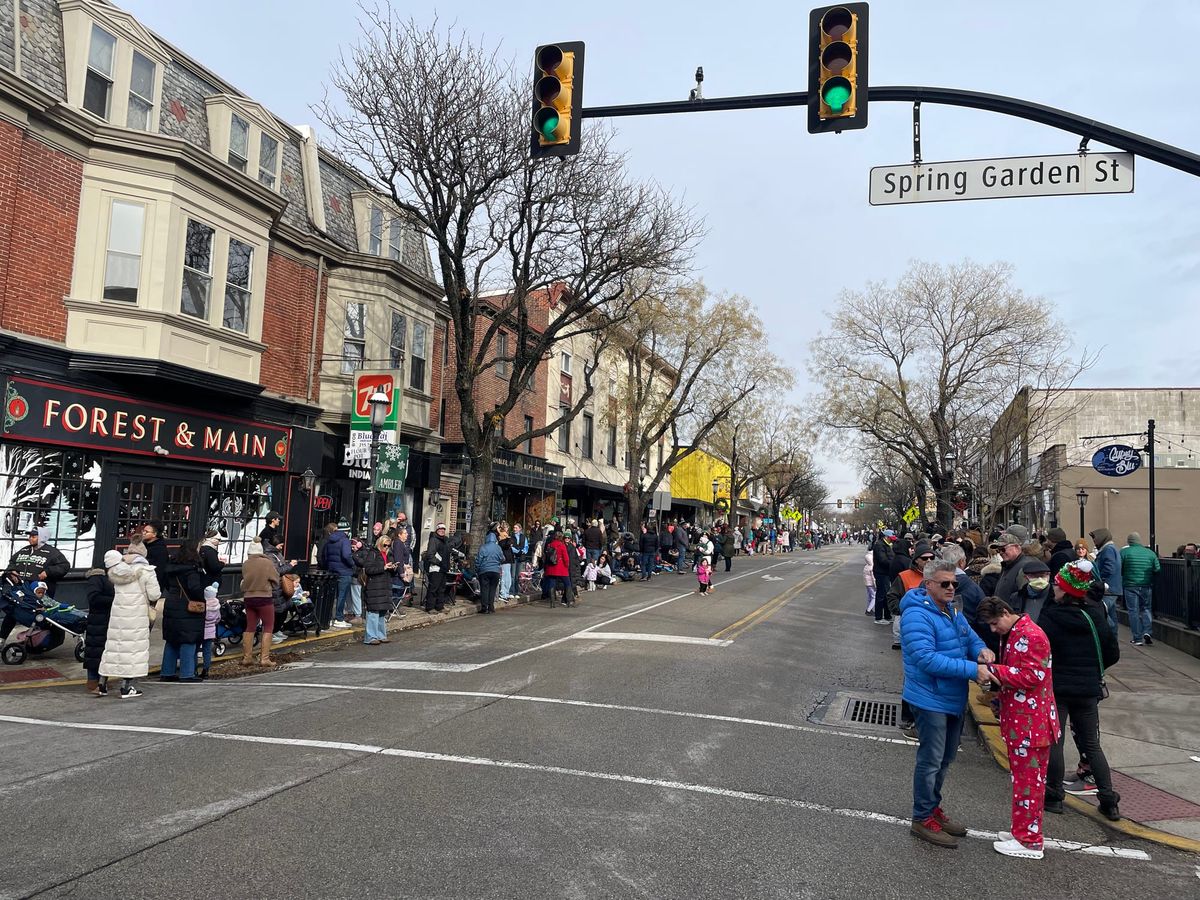
The photo at the very top shows people gathering in downtown Ambler, Pa., before the annual Christmas parade, where all manner of local organizations — churches, scouting troops, civic groups, student marching bands, youth sports teams, ethnic heritage associations – march through the street, waving and perhaps tossing candy at onlookers gathered on the sidewalks.
Below is a photo of "First Friday," an event held in Ambler five times a year where Butler Ave., the main commercial corridor, is opened to pedestrians, restaurants, merchants, live music.
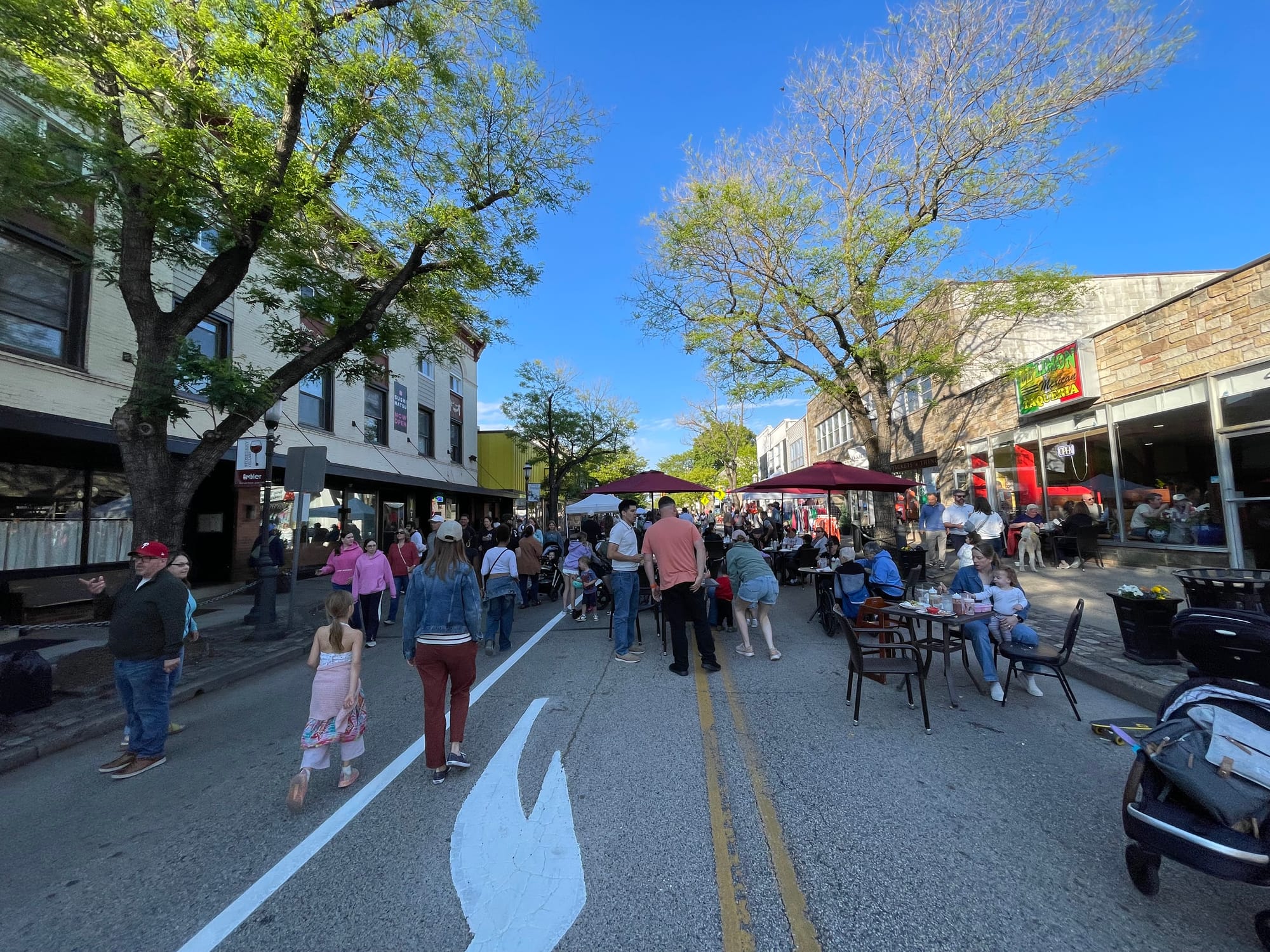
The point is, what makes these events special is not the feats of the participants, no offense to the Mummers or the Sons of Italy. What's special is a bunch of people coming together. If you're a local, you'll likely see lots of people you know, but the great majority of those who create the special ambiance are strangers. It's nice to be around them.
I feel like this is worth pointing out because there are so many forces in society conspiring against human interaction.
The big one is technology, of course. Nobody needs to ask for directions or the time anymore and there's also no reason to ask the store clerk for a product recommendation when you supposedly have the wisdom of 100,000 store clerks in your pocket. In fact, why even bother going to the store?
Traditional media, particularly TV, has been feeding people the impression for decades that the world is far more dangerous than it is. My sense is that social media has only made things worse. It's common, at least in my experience, for parents today to mistakenly believe that kids can't be allowed the same degree of freedom that we enjoyed because the threat of kidnappers, sexual predators and other villains is higher than ever before.
Finally, there are our misanthropic politics. The fact that your neighbor might be a member of the hated rival political tribe gives you one more reason to avoid him.
It then makes perfect sense that Elon Musk, avatar of tech-fueled hate and paranoia, would describe proximity to strangers as an experience fraught with peril. This is what he said in 2017 about public transit:
"I think public transport is painful. It sucks. Why do you want to get on something with a lot of other people, that doesn’t leave where you want it to leave, doesn’t start where you want it to start, doesn’t end where you want it to end? And it doesn’t go all the time. It’s a pain in the ass. That’s why everyone doesn’t like it. And there’s like a bunch of random strangers, one of who might be a serial killer, OK, great. And so that’s why people like individualized transport, that goes where you want, when you want."
Look, I am keenly aware that public transit in this country is often very shitty. Trains in Philly were catching on fire last year. But Musk wasn't just putting down bad public transit, he was dismissing the entire premise of public transit. According to Musk, even the Paris Metro sucks. Being around strangers is a threat one should avoid.
The good news is that I don't think most people agree. I think most people actually recognize that large numbers of people can actually make things safer. A crowded subway station or street often feels safer than a vacant one.
At the risk of stating the obvious, being around other people presents risks and opportunities. The same could be said about anything else in life to which we aspire: love, parenthood, gainful employment. There's indeed a chance the stranger you're sitting next to on the bus is a serial killer, but they're more likely to be a future friend or spouse.
There's been a lot of talk about the loneliness epidemic lately. Numerous surveys have shown that Americans spend less time with friends and have fewer friends than a generation ago. Writing recently for the Cut, Monica Corcoran Harel describes married men as particularly prone to friendlessness. If loneliness and social isolation aren't bad enough on their face, they also correlate with all kinds of bad health outcomes, including earlier deaths.
Friends are important, and making new friends as an adult is hard. But every new friend begins as a stranger. Which is why I think it's important for communities to recognize the value of activities and spaces that encourage large numbers of strangers to gather.
Local governments should take human interaction into account when making decisions about land use, infrastructure, public spaces, and even social services and public safety. Will this decision encourage or discourage people from mixing?
In my next article, I'll describe an example of a local park that I believe would have turned out very differently if the human interaction lens were applied.