In an earlier article I highlighted the fact that what is remarkable about birth rates over the past century is not the steady decline, which we continue to see now, but the 15 years when it skyrocketed following World War II.
If we accept the premise (and I don't, necessarily) that the ongoing decline in birth rates reflects a general pessimism or insecurity about the future, then why were people feeling so good about things in the midst of bloody wars and an ever-present threat of nuclear annihilation?
One tempting explanation for why people felt more confident about the future was that, despite all of the threats, they had tremendous confidence in their government.
There are no figures on how people felt about government before the 50's, but it seems pretty clear that World War II and the subsequent years were times of incredibly high trust in American institutions. In 1964, 78% of Americans said they trusted the U.S. government to do what is right "most of the time."
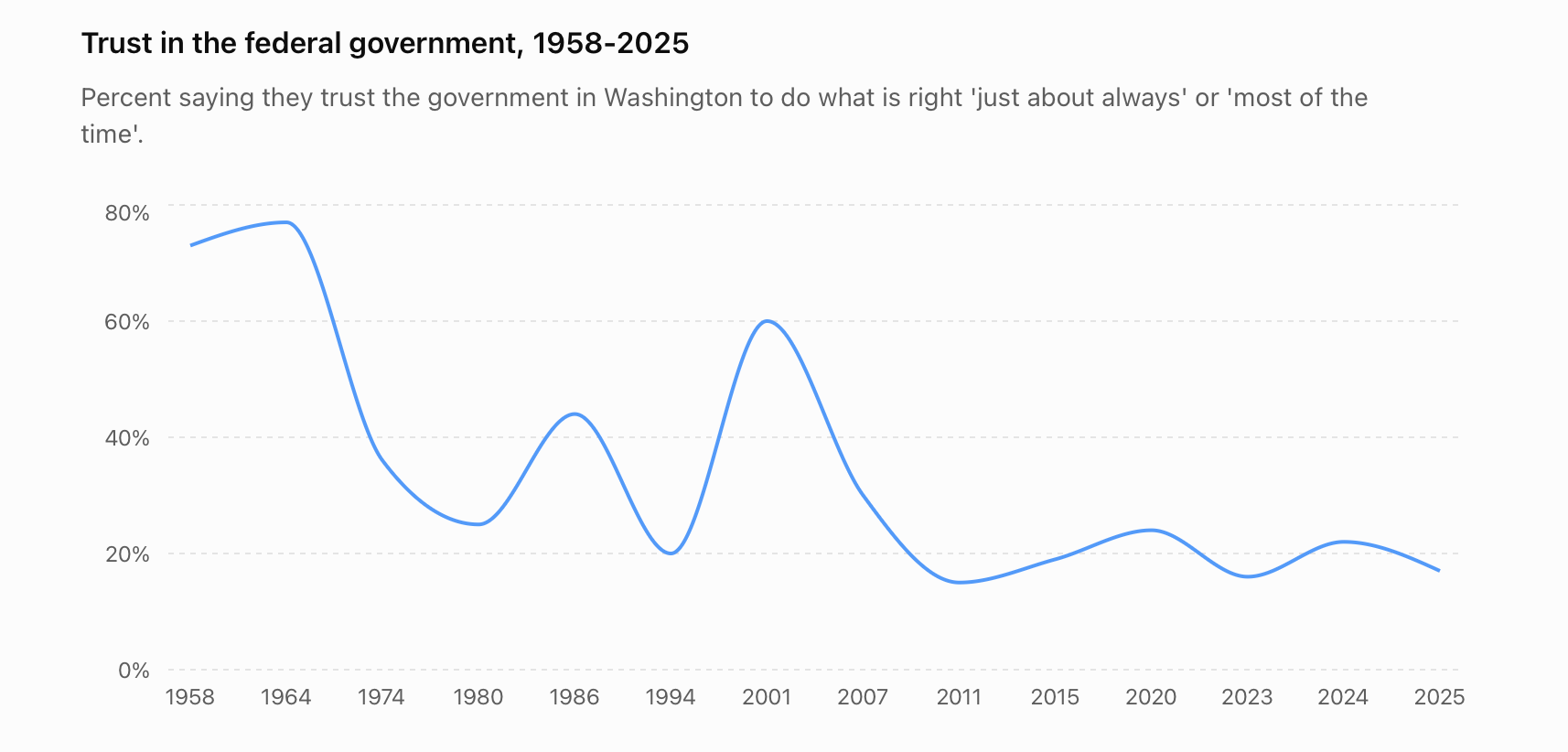
Confidence in the U.S. government cratered in response to Vietnam and Watergate and only briefly rose above 50% in the wake of 9/11. Things have been particularly bleak since. For most of the past three decades trust in the federal government has hovered around 20%.
The level of national unity on display during World War II and the early years of the Cold War is unfathomable today. We all agreed on the problem and put our trust in our leaders to solve it, even as thousands of men returned home in coffins each month and we seemed to be hurtling towards nuclear apocalypse. Americans were deeply divided in many ways — racial, religious, cultural, political — but they were bounded by trust in their leaders. We all agreed that the big enemies were fascism and communism, not fellow Americans (with the notable exception, unfortunately, of Japanese-Americans).
Now, in contrast, the thing we all share is that we're all scared shitless of half of the country. When the other side wins an election, it's no longer merely disappointing but terrifying.
To be clear, I believe the distrust for our current leaders, particularly the psychopath in the White House, is well-earned. The problem is that I'm not sure that electing better leaders will significantly improve trust in the federal government because the information people are getting from partisan media and social media is so overwhelmingly aimed at sowing anger and paranoia about national politics.
But Americans are not nearly as cynical about local government.
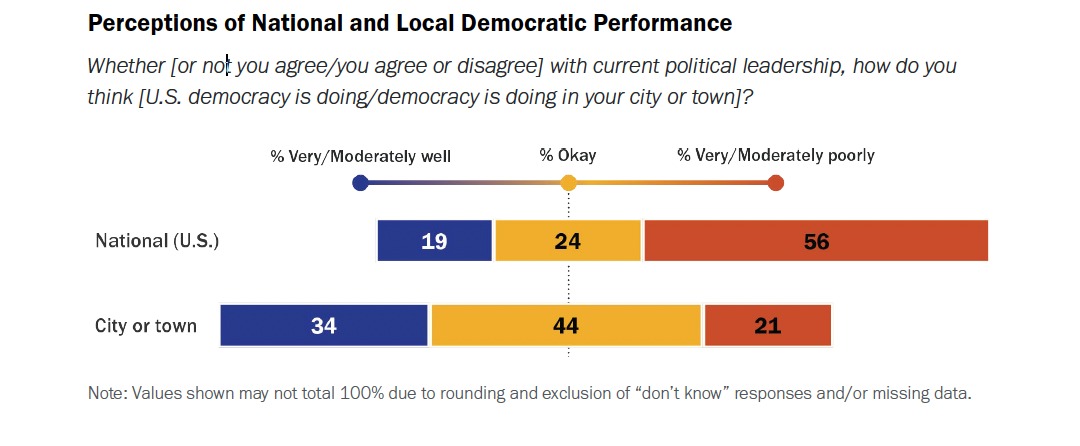
There are a couple obvious explanations.
First, you're more likely to trust people who are closer to you and who you're more likely to have met personally.
Second, local government officials, particularly those working on a volunteer basis in small or mid-size cities, are more likely to be motivated by service than power. Don't get me wrong: there can be vicious power struggles at even the lowest levels of politics, but these types of roles don't select for megalomaniacs like Congress does.
Finally, local politics isn't subject to a constant barrage of divisive coverage from partisan media outlets and social media personalities. Whatever emaciated local press still exists in your community is far less likely to engage in partisan sensationalism. And if you're seeing anything on social media about local government, it's probably coming from normal human beings in the community rather than rage bait bots.
The irony is that the dramatic decline of local news outlets makes it much easier for corruption to fester in local government. I can guarantee you that the average American knows far less about what's going on in their local government than they did two decades ago.
Obviously this is not ideal. But the trust that Americans generally have for people in their own communities is still an important bulwark against the division tearing us apart at the national level. I think that encouraging people to pay attention to and get involved in local government is a good way to combat the sense of helplessness and hopelessness that national politics has unleashed on us.
It would be much easier to do so if there are reliable sources of local news. Which is why I think local news nonprofits are one of the best ways wealthy philanthropists can support their communities and the country.
That's all I've got for today! Please forward to friends and family and encourage them to subscribe to the newsletter. And if you truly appreciated this article, you can show your appreciation by making a one-time donation or setting up a recurring monthly donation. I appreciate your support!
Why do people trust local government more?
A look at the crazy decline in trust for the federal government.