Why the Baby Boomers are so special
There's a lot of talk about why we're not having babies. There's not enough talk about why people in the 50's had so many.

Everyone's talking about birth rates. It's the thing to write about in prestige publications. I'm less interested in what it says about us than the cold hard fact that Social Security is going bust unless we start making more babies or importing people who will make babies.
Before I looked at the data, I would have guessed the story of American fertility was one of gradual, steady decline. That narrative certainly aligns with my family's experience. Both sets of grandparents had five kids, my parents had three and I have one, as do each of my brothers (so far). The story is similar on my wife's side of the family.
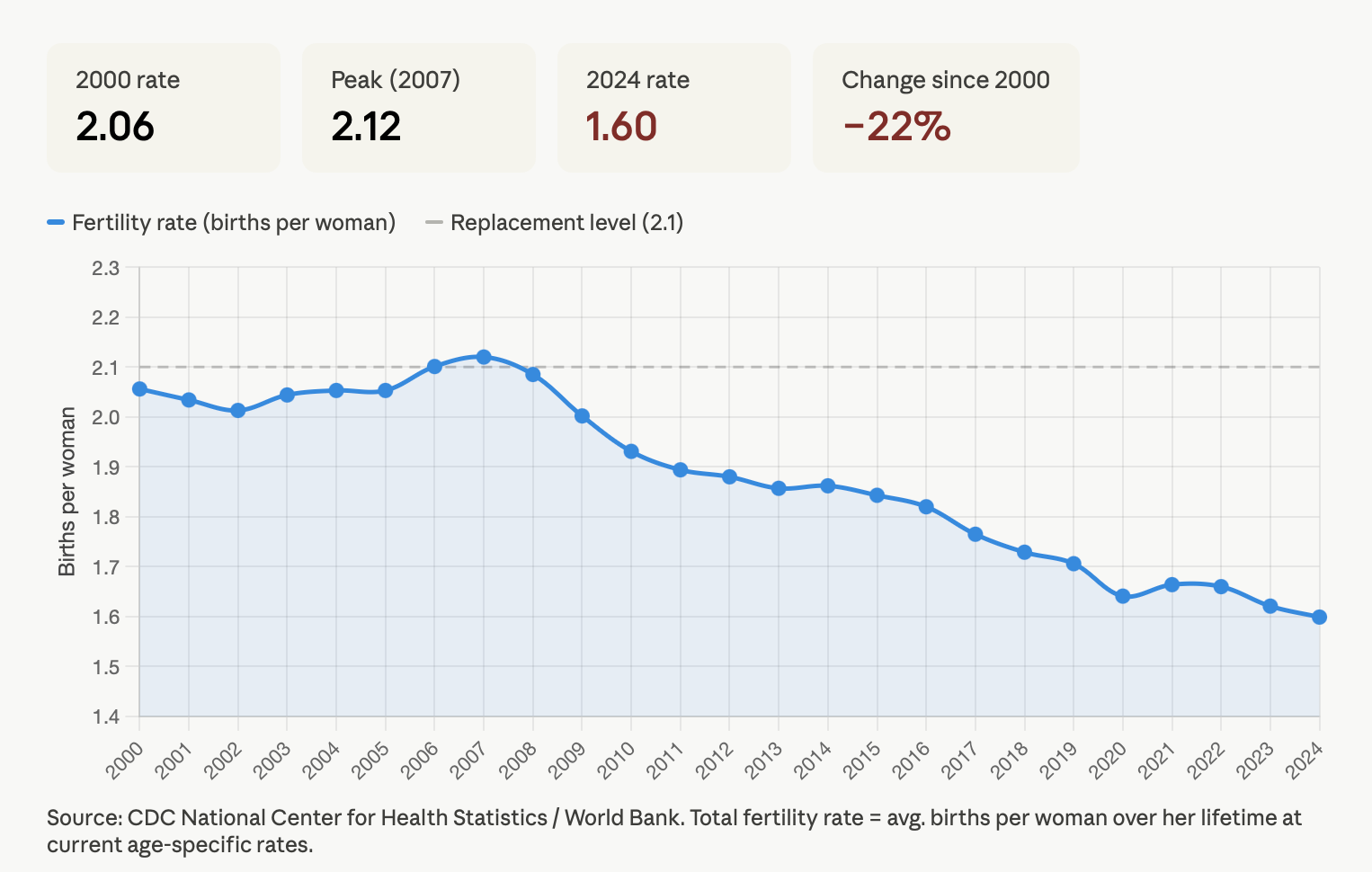
I think the reason I had that impression is because much of the despair voiced about our lack of babies focuses on the very recent history. Here's the situation since the beginning of the 21st century:
But let's zoom out a little further:
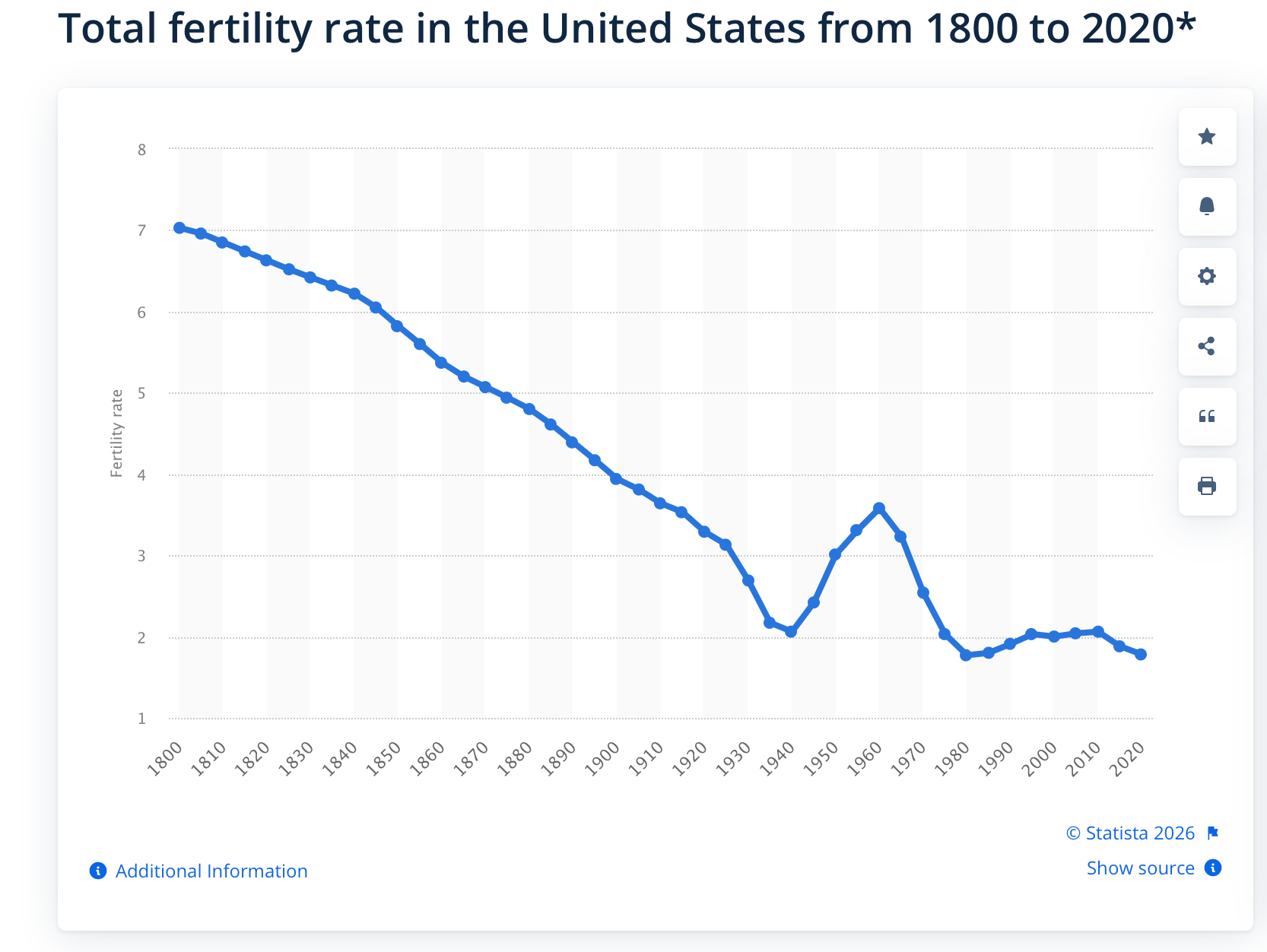
In 1800 American women had an average of seven live births in a lifetime, although barely half of their babies survived to adulthood. The birth rate (like the child mortality rate) then steadily declined for 130 years, falling below 3 births per woman in 1930. The rate then plunged during the Great Depression, falling to just above 2 in 1940.
And then....
BOOM!
The Baby Boom changed everything. For the first time in the nation's history, the birth rate skyrocketed, peaking at 3.65 births per woman in 1960.
Just think about that. What happened in the years following World War II was a far more abrupt change in baby-making trends than anything that has happened since.
And then in the 60's the birth rate plummeted again. And in 1972, for the first time ever, the birth rate dropped below what is generally considered replacement level (2.1 births per woman).
Broadly speaking, the birth rate was low in the 70's and 80's and but then rose in the 90's and 2000's, topping out at 2.12 in 2007. And then things took a dive after the Great Recession.
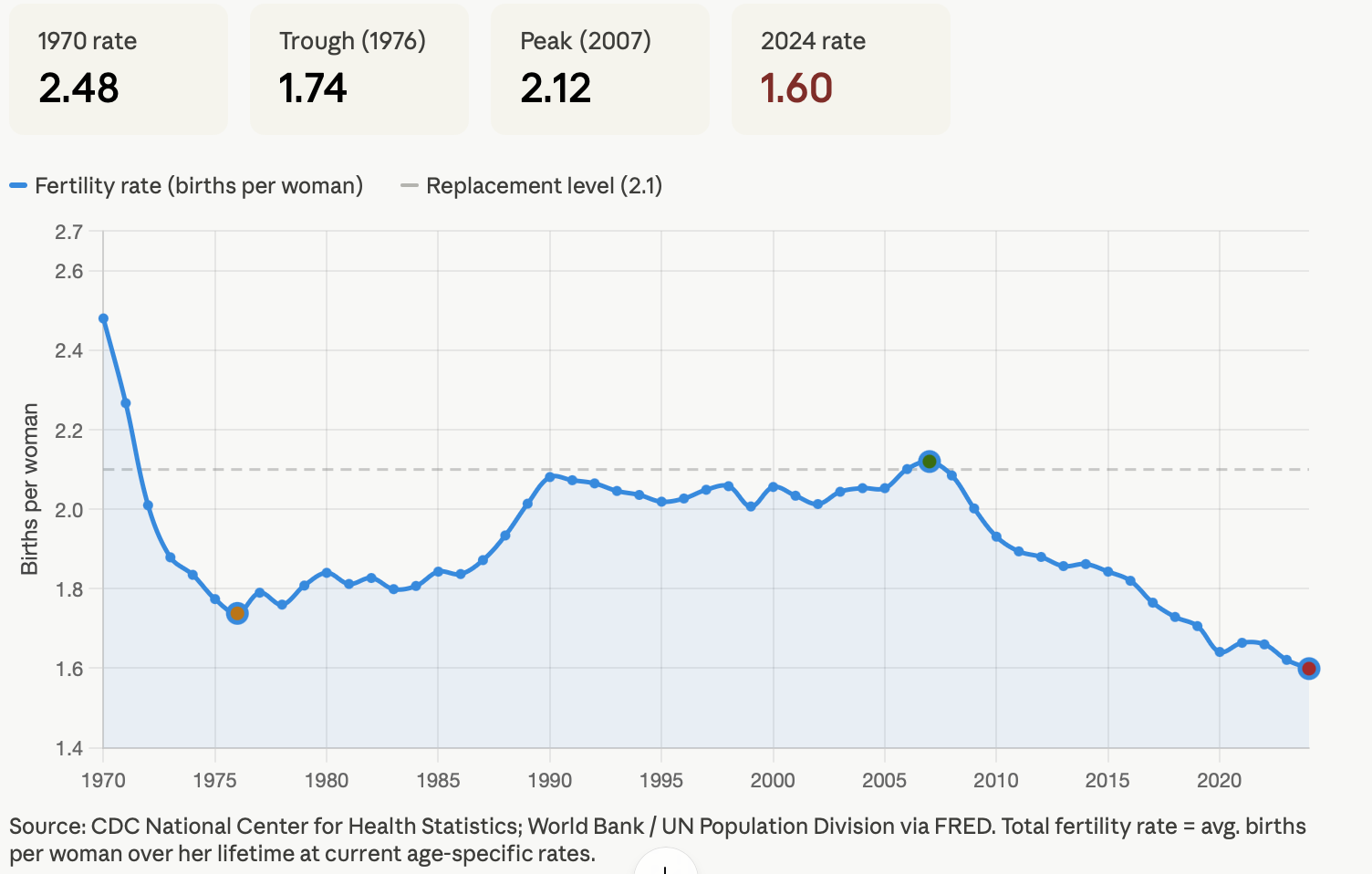
If nothing else, this graphic should discredit the right-wing impulse to blame the current baby bust on feminism and women's rights. There were far more girlbosses in 2007 than in 1972, and yet our fertility rate was higher. We were more feminist and more fertile! Yes, a rise in immigration (and higher fertility rates among immigrants) played a role, but fertility rates were also higher among native-born women.
There are all kinds of takes on why the birth rate has now declined to unprecedented depths across the entire industrialized world (and even many middle-income countries like India, Brazil and Mexico). Smartphones, the cost of living and climate change are all popular arguments.
In a guest column for the New York Times earlier this year, Anna Louie Sussman, author of Inconceivable: The Impossibility of Family in an Age of Uncertainty, suggested the culprit is anxiety — about the economy, the climate, political instability. Here are couple key excerpts I'd like to zero in on:
Raising children is an inherently forward-looking project, and in Professor Vignoli’s analysis, increasing exposure to a volatile global economy and accelerating technological change make it hard for young people to project a path forward with even a modest degree of confidence.
...As with any sweeping social change, more than one factor is at work, but a growing body of evidence suggests that the anxiety of bringing a child into such an uncertain world may increasingly outweigh the appeal of motherhood.
I'm not entirely convinced by this explanation but it's certainly plausible. For the sake of this article, let's assume it's correct.
But first, it's important to put things in perspective. Only about 19% of U.S. women aged 40-44 don't have any children. That's a big increase from the childless share in 1980 (10%), but it still means 81% of millennial women were not too depressed about the future of the world to bring a child into it. The low fertility rate has as much to do with families choosing to have fewer children than forgoing them altogether. I suppose the uncertainty/anxiety hypothesis could help explain that trend as well. I've certainly met people who say they'd have more kids if they had greater confidence in their future earnings.
But if we want to figure out what's keeping us from reproducing now, I think it's worth pondering what exactly what was pushing us to so prodigiously conceive in the middle of the 20th century.
What was going so right in 1950?
On the bright side, the economy was rapidly growing. The pie was certainly not divided equally, but everyone — including those at the very bottom — was getting richer in the post-war boom years. The free world had just triumphed over fascism; Americans of all political and cultural stripes were bound by the belief that we were the good guys building a better future for mankind.
But it's not hard to put a much darker spin on 1950. We were only a few years removed from the most horrendous war in human history that cost America over 400,000 young men and no doubt traumatized millions of others. This was a war where the good guys killed over a million civilians. How do you come out of that with faith in humanity? Plus, the jubilation of beating the fascists was quickly replaced by an all-encompassing fear of the communists, who had also discovered the technology to instantly vaporize cities! Did I mention we were already in the midst of another hot war in Korea that killed 36,000 Americans? Why is a world seemingly on the brink of nuclear apocalypse the one you'd want to bring a child into?
There are plenty of reasons to feel crappy about the world today. But there were plenty of reasons to feel crappy about the world in 1950. And western world people were breeding like rabbits. Why? I don't know. But it seems like an important question for the burgeoning class of fertility pundits to answer.
Please subscribe to Neighborhood Matters for more reporting and writing on urbanism, family and community. It's totally free.